

Maximum compression strain in concrete is the strain at which concrete is assumed to crush in limit‑state design, typically taken as 0.0035 in flexure and 0.002 in axial compression as per IS 456:2000.
These limiting strains are fundamental in limit state design concrete strain calculations for beams, slabs, and columns. They come directly from the simplified concrete stress-strain curve and the assumptions given in IS 456 for the ultimate limit state of collapse.
Definition of Maximum Compression Strain in Concrete (IS 456)
In IS 456 limit state design, maximum compression strain in concrete is the highest usable strain assumed at the outermost compression fiber when the section reaches the ultimate limit state.
- In flexural members (beams and slabs), the maximum strain in concrete IS 456 taken at the outermost compression fiber is 0.0035 in bending at collapse.
- In compression members (columns and axially loaded members), the maximum compressive strain in concrete in axial compression is taken as 0.002.
These values are used to derive the design stress block and to check whether a section is balanced, under-reinforced, or over-reinforced in the limit state design concrete strain approach.
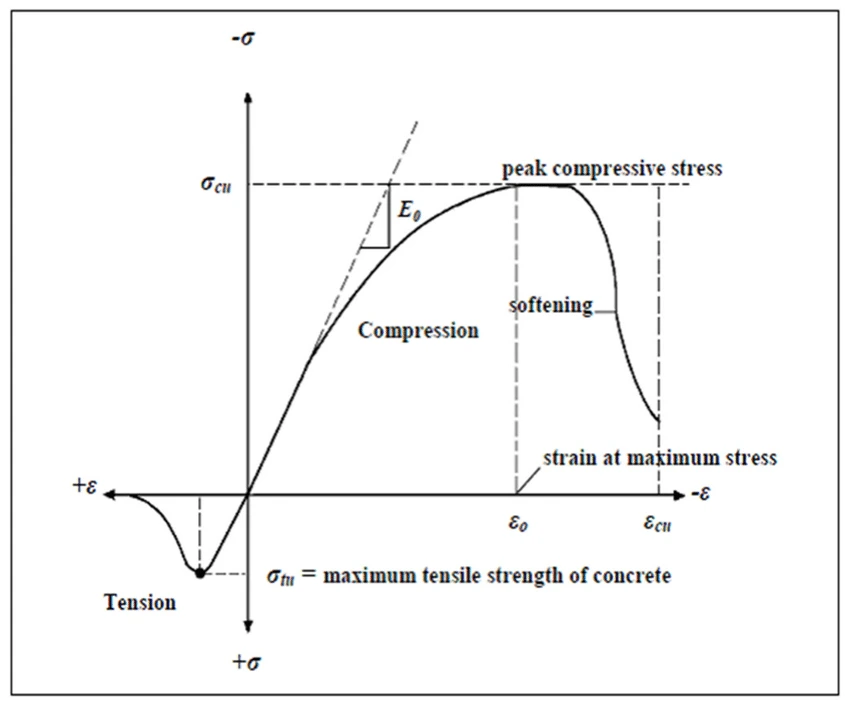
Further ref Source: IS 456:2000: Section 38.1 (Assumptions for Limit State of Collapse: Flexure).
Why Is Maximum Strain Taken as 0.0035 and 0.002?
The values 0.0035 and 0.002 are simplified limits taken from the experimental concrete stress‑strain curve for normal‑weight concrete.
- Up to about 0.002 strain, the stress in concrete increases almost linearly with strain.
- Beyond roughly 0.002, the slope of the curve reduces, and concrete gradually approaches crushing.
For flexural members, IS 456 assumes that at the ultimate limit state, the strain at the outermost compression fiber reaches 0.0035. This higher limit allows a realistic rectangular or parabolic‑rectangular stress block to be used in design while still remaining on the safe side.
For axial compression members, the code restricts the maximum compressive strain in concrete to 0.002. This lower limit reflects the more uniform compression and ensures sufficient safety against sudden crushing failure in columns and similar members.
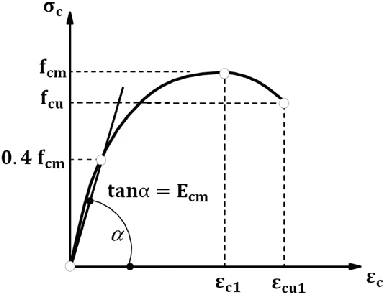
Further ref Source : EN 1992-1-1 (Eurocode 2): Table 3.1 (Strength and deformation characteristics for concrete).
Concrete Stress–Strain Curve and Design Assumptions
The actual stress–strain curve of concrete in compression is non‑linear, but for design we use a simplified model.
- The initial part of the curve is almost linear up to a strain of about 0.002.
- Between about 0.002 and 0.003 to 0.0035, the curve becomes flatter and the stress reaches a near‑constant maximum value.
IS 456 uses a parabolic‑rectangular or rectangular stress block based on these observations. At the ultimate limit state in bending, the strain at the compression face is taken as 0.0035, and the corresponding stress block parameters are derived from this assumption.
For axial compression and combined bending and axial load, the code limits strain to 0.002 or to formulas based on the highly compressed extreme fiber, again derived from the same concrete stress-strain curve behavior.
Limit State Design Assumptions for Concrete Strain (IS 456)
Limit state design is a strain‑based approach. It checks whether the ultimate strain limits in concrete and steel are reached under factored loads. The key assumptions in IS 456 for flexure directly involve maximum compression strain in concrete and the strain distribution across the depth.
- Plane sections normal to the axis remain plane after bending. This means that the strain distribution is linear across the depth at any section.
- The maximum strain in concrete at the outermost compression fibre at the limit state of collapse in bending is taken as 0.0035.
- The tensile strength of concrete is ignored in flexural strength calculations, and all tension is carried by steel.
- The design compressive strength of concrete is taken as 0.67 times the characteristic strength, divided by a partial safety factor of 1.5.
For members in direct compression, the maximum strain in concrete IS 456 allows is 0.002. These simple but powerful assumptions allow the designer to define stress blocks, compute ultimate moment of resistance, and check overall safety of the member.
Maximum Compression Strain in Axial Compression and Combined Flexure
For a short axially loaded column designed by the limit state method, IS 456 specifies that the maximum compressive strain in concrete in axial compression is taken as 0.002. This value is lower than the flexural limit of 0.0035 to provide a margin of safety under uniform compression.
When a member is subjected to axial compression and bending, and when there is no tension on the section, IS 456 defines the maximum compressive strain at the highly compressed extreme fibre as:
IS 456 Combined Loading Formula:
εc,max = 0.0035 − 0.75 × εleast
where εleast is the strain at the least compressed extreme fibre.
This expression shows that the limit state design concrete strain varies between 0.0035 and 0.002 depending on the strain state of the section.
For purely axial compression (no bending), the least compressed extreme fibre has the same strain as the most compressed fibre. Therefore the strain becomes 0.002, which matches the axial limit specified by the code. For high bending and low axial compression, the strain at the compression face approaches 0.0035, which is the flexural limiting value.
Parabolic–Rectangular Stress Block and Concrete Strain
The simplified concrete stress strain curve used in IS 456 is represented in design by a parabolic–rectangular stress block. This block is used to calculate the resultant compressive force in the concrete and its lever arm.
- From the neutral axis up to a strain of about 0.002, the stress distribution is taken as parabolic.
- From a strain of 0.002 up to the ultimate strain of 0.0035 at the compression face, the stress is taken as constant, forming the rectangular part.
This combined shape is equivalent to a single rectangular block with an effective depth and intensity, often simplified further for design. The depth of the resultants and the factor 0.36 or 0.42 used in moment calculations come from integration of this parabolic–rectangular stress block.
In practical design, the engineer does not integrate the concrete stress strain curve each time. Instead, the code provides ready stress block parameters that are compatible with the assumed ultimate strain values of 0.0035 in bending and 0.002 in axial compression.
Balanced, Under‑Reinforced and Over‑Reinforced Sections (Strain View)
The classification of a flexural section as balanced, under‑reinforced or over‑reinforced is based on the strain pattern at ultimate load. The concept is directly linked to maximum compression strain in concrete and the yield strain of steel.
Balanced Section Strain in Concrete
A balanced section is one in which the concrete at the compression face reaches the limiting strain of 0.0035 at the same time that tensile reinforcement just reaches its design yield strain. This condition defines the balanced section strain in concrete and the critical depth of neutral axis.
At this balanced condition, any further increase in load will cause both materials to exceed their limiting strains. Therefore the depth of the neutral axis at this state is called the limiting or critical neutral axis depth. It depends mainly on the grade of steel and to a lesser extent on the grade of concrete.
Under‑Reinforced Section
In an under‑reinforced section, the amount of tensile steel is less than that in a balanced section. At ultimate, the steel reaches its yield strain before the concrete reaches 0.0035. The neutral axis and maximum strain pattern in this case gives large tensile strains in steel, visible deflections, and cracking before failure.
Such behaviour is ductile and desirable. The design philosophy of limit state method encourages under‑reinforced sections so that failure is governed by steel yielding, not by sudden concrete crushing.
Over‑Reinforced Section
In an over‑reinforced section, the amount of tensile steel is greater than that in a balanced section. As the load increases, the concrete reaches the limiting strain of 0.0035 first while the steel is still within the elastic range. The failure is governed by concrete crushing in compression, and the warning signs are minimal.
Over‑reinforced sections are avoided in design because the brittle compression failure is not acceptable. IS 456 limits the depth of neutral axis and provides maximum percentage of tensile reinforcement to keep sections under‑reinforced or at most balanced.
Strain Compatibility and Neutral Axis Depth
In limit state design, the depth of neutral axis is obtained from strain compatibility and force equilibrium. The strain diagram is assumed linear from the compression face to the level of tensile reinforcement.
Strain Compatibility Equation
For a singly reinforced rectangular section:
εc / xu = εs / (d − xu)
Where:
- εc = strain at top compression fibre (0.0035 at ultimate in bending)
- εs = strain in tensile steel
- xu = depth of neutral axis from compression face
- d = effective depth of section
Balanced Condition: εc = 0.0035 and εs = limiting design steel strain
Result: xu,lim (limiting neutral axis depth)
For different steel grades, xu,lim changes slightly because the yield strain of steel (εs) varies.
Along with this strain relationship, the compressive force in concrete obtained from the stress block is equated to the tensile force in steel. The combination of these equations gives both the neutral axis and maximum strain state and the ultimate moment of resistance.
Neutral Axis and Maximum Strain in Limit State Design
In a reinforced concrete beam or slab in bending, the strain distribution across the depth is assumed to be linear. The top is in compression, the bottom is in tension, and the line where strain is zero is the neutral axis.
The relationship between the neutral axis and maximum strain is governed by strain compatibility. For a singly reinforced rectangular section:
Strain Compatibility Equation
Linear strain distribution across beam depth:
εc / xu = εs / (d − xu)
Symbol Legend:
| Symbol | Description |
|---|---|
| εc | Compressive strain at top fiber (0.0035 at ultimate) |
| εs | Steel strain at tensile reinforcement level |
| xu | Neutral axis depth from compression face |
| d | Effective depth of section |
Key Point: This equation defines the neutral axis and maximum strain relationship in limit state design concrete strain analysis per IS 456:2000.
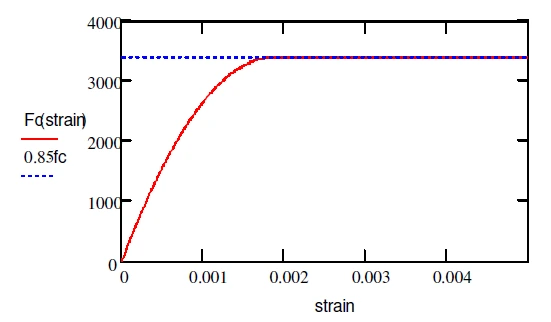
Further Study ref : ACI 318-19: Section 22.2.2.1 (Design assumptions for moment and axial strength).
Depending on how these strains reach their limiting values, the section behavior is classified as
- Balanced section: concrete strain reaches 0.0035, and steel strain reaches its design limit at the same time. This gives the balanced section strain in concrete and the critical neutral axis depth.
- Under-reinforced section: steel yields (large tensile strain) before concrete reaches 0.0035, leading to ductile flexural failure.
- Over‑reinforced section: concrete reaches 0.0035 first while steel is still elastic, causing brittle compression failure and hence discouraged in design.
Numerical Example on Maximum Compression Strain and Neutral Axis
Numerical Example: Neutral Axis Calculation
Problem: A singly reinforced rectangular beam has effective depth d = 500 mm. At ultimate limit state, εc = 0.0035 and εs = 0.002. Find neutral axis depth xu.
Step 1: Strain Compatibility
εc / xu = εs / (d − xu)
Step 2: Substitute Values
0.0035 / xu = 0.002 / (500 − xu)
Step 3: Cross‑Multiply & Solve
0.0035 × (500 − xu) = 0.002 × xu
1.75 − 0.0035 xu = 0.002 xu
1.75 = 0.0055 xu
xu ≈ 1.75 / 0.0055 ≈ 318 mm
Key Insight: This shows how limit state design concrete strain values (0.0035, 0.002) directly control the neutral axis and maximum strain position.
MCQ Tip (Exam Orientation)
- In bending, the maximum strain in concrete at the outermost compression fiber in limit state design is always taken as 0.0035.
- In axial compression, the maximum compressive strain in concrete is taken as 0.002.
- Questions often ask you to identify whether a section is under‑reinforced, over‑reinforced, or balanced based on these limiting strain values and the resulting neutral axis position.
Practice Question on Maximum Compression Strain in Axial Compression
As per IS 456:2000, the maximum compression strain in concrete in axial compression is taken as
A) 0.002 B) 0.0035 C) 0.0025 D) 0.003
Explanation:
According to IS 456:2000, Plain Concrete and Reinforced Concrete Code of Practice (Clause 6.2), the maximum usable compressive strain in concrete in axial compression is taken as 0.002. This value is applicable for design calculations.
The choice of 0.002 as the maximum compressive strain is based on the stress-strain curve of concrete, where beyond a strain of 0.002, the slope of the curve decreases significantly, indicating impending failure. Limiting the maximum compressive strain to 0.002 provides a factor of safety against failure in design.
Therefore, option A is the correct answer.
Options B, C, and D are incorrect values as per IS 456:2000. The maximum compressive strain of 0.0035 may be achieved in some high-strength concrete, but 0.002 is specified by IS 456 for design. Options C and D are also not the specified maximum strain values.
FAQ: Maximum Compression Strain in Concrete (IS 456)
What is the maximum compression strain in concrete as per IS 456:2000 in flexure?
For flexural members like beams and slabs, the maximum strain in concrete at the outermost compression fibre in limit state design is taken as 0.0035
What is the maximum compression strain in concrete in axial compression?
For members in axial compression, IS 456 takes the maximum compressive strain in concrete as <strong>0.002</strong> for design purposes.
Why is maximum strain in concrete taken as 0.0035 in bending?
The value 0.0035 comes from the simplified <strong>concrete stress-strain curve</strong> used in IS 456. It represents the usable crushing strain at the compression face at the ultimate limit state in flexure.
How is maximum compression strain related to the neutral axis?
The assumed maximum compression strain at the top fiber (0.0035 in bending) and the tensile strain in steel define the slope of the strain diagram. From this, the depth of the neutral axis is obtained using the strain compatibility equation.
What is meant by balanced section strain in concrete?
In a balanced section, the strain in concrete reaches 0.0035 at the same time as the tensile steel reaches its limiting strain. This balanced section strain in concrete gives the critical neutral axis depth and separates under‑reinforced and over‑reinforced behavior.
Practical Notes for Design and Exams
From a practical design point of view, remembering the limiting strain values and patterns can simplify many exam‑oriented and field calculations. The following points are useful for both GATE and design work:
- In flexural design, always remember 0.0035 as the maximum compression strain in concrete at the outermost fibre in bending at ultimate limit state.
- In axial compression, remember 0.002 as the maximum compressive strain in concrete, as required by IS 456.
- For combined compression and bending with no tension, the maximum strain lies between 0.002 and 0.0035 and is controlled by the strain at the least compressed fibre.
- The shape and parameters of the concrete stress block are derived from integration of the idealised concrete stress strain curve up to these limiting strains.
- Classification into balanced, under‑reinforced and over‑reinforced sections is done by comparing actual neutral axis depth with the limiting depth obtained using limit state design concrete strain and steel strain.
These simple rules connect the theory of strains with day‑to‑day design and typical multiple‑choice questions on maximum compression strain in concrete in codes like IS 456:2000.
Comparison of Maximum Compression Strain Values in IS 456
| Situation | Strain Value | Remarks |
|---|---|---|
| Flexural members (beams, slabs) at ultimate limit state | 0.0035 | Maximum strain in concrete at the outermost compression fiber in bending. |
| Axial compression members (columns, walls) | 0.002 | Maximum compressive strain in concrete in axial compression. |
| Combined axial compression and bending (no tension) | Between 0.002 and 0.0035 (as per code expressions) | Depends on the strain at the least compressed extreme fiber. |