

Septic tanks are a crucial component of decentralized wastewater management systems. Proper septic tank design is essential to ensure effective treatment of sewage from individual households or buildings before discharge or reuse.
Septic Tank Design: An Introduction
Septic tanks offer a preliminary treatment of sewage before final disposal. The sewage is held in these tanks for a prescribed period, allowing suspended solids to settle down. The settled sludge and supernatant liquor undergo anaerobic digestion, significantly reducing the sludge volume and organic matter in the liquid.
IS: 2470 (PART 1) – 1985 provides recommendations for the design, layout, construction, and maintenance of septic tanks, applicable to houses, flats, residential colonies, hostels, and boarding schools with up to 300 users. In unsewered areas, every house should have a septic tank for sewage treatment, with the effluent receiving secondary treatment in a biological filter, up-flow anaerobic filter, on land, or in a subsurface disposal system.

Proper design, construction, and maintenance of septic tanks are crucial for effective sewage treatment. This introduction aims to provide guidance to local bodies, public works departments, and others engaged in this field, ensuring the implementation of efficient septic tank systems.
What is a septic tank? – Purpose and Importance
A septic tank is an underground chamber made of concrete, fiberglass, or plastic that collects and treats sewage from a building or facility not connected to a sewerage network.
Key functions of a septic tank:
- Collects all wastewater from toilets, sinks, washing machines, etc.
- Separates settleable and floating solids from the liquid.
- Provides preliminary treatment by anaerobic digestion of organic matter.
- Reduces BOD, TSS, and pathogenic organisms in sewage.
- Removes debris, grit, grease, and scum from effluent.
- Distributes partially treated effluent for further treatment.
Well-designed septic tanks are critical for public health protection by ensuring proper sanitation in areas lacking centralized sewerage infrastructure.

Septic Tank Size Calculations
Septic tank capacity depends on the number of users, wastewater generation, and retention time required. The main sizing parameters are
- Number of users—Consider residential occupancy or number of employees/visitors for commercial buildings. Also account for any future expansion.
- Wastewater flow rate—Use typical values of sewage generation rates per user. Varies from 100 to 200 liters/person/day based on water supply.
- Retention time—1-3 days retention time is ideal. Provides sufficient hydraulic retention time for settling and anaerobic digestion.
- Sludge storage—The bottom one-third of the tank height is reserved for accumulated sludge.
- Scum storage: Top one-tenth for floating scum layer.
Calculate the total volume based on these factors. Multiple compartments can split the volume to improve settling.
Septic Tank Size Calculation
Septic tank size calculation: 70-80 L/person/day × 2 days retention. 5 users = 700-800 L ≈ 1 m³/min.
Ex: 10 users → 1.6 m³. Add 300 mm freeboard. Cleaning interval affects liquid depth.
Baffles in Septic Tank
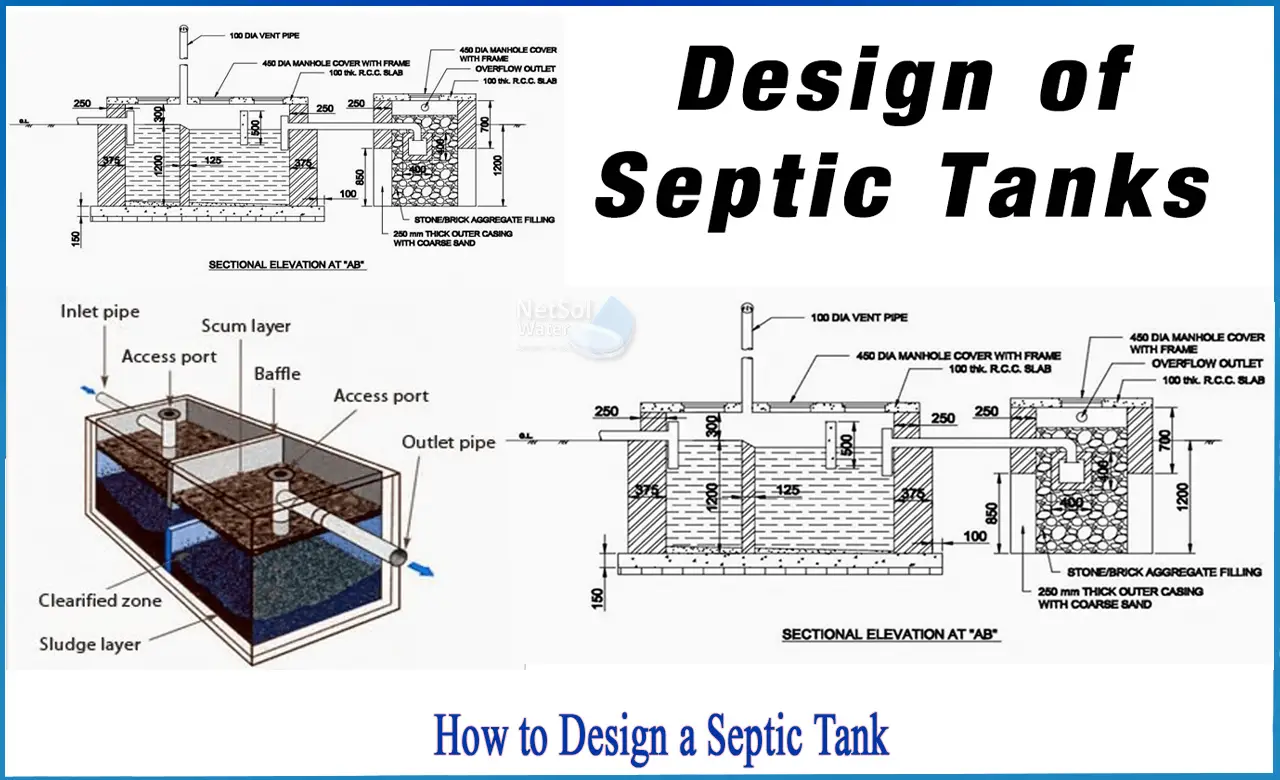
Baffles in the septic tank prevent scum disturbance. Inlet T‑dip 300 mm below water, outlet 1/3 depth.
Widths greater than 1200 mm require two inlets. Fixed 150 mm from the end.
Septic Tank Detention Period
Septic tank detention period: 24 hours, typically. Allows settling & anaerobic digestion.
Soak Pit Design Rules
Soak pit design rules: 3-4 m deep, 1.2-1.5 m dia. Gravel has 30-40% voids. 10-15 m from the tank/well.
Andhra Soil Perc Test Tips
Andhra red soils need a perc test. Good perc (>12 min/inch) → standard soak pit. Poor dispersion trench.
“Download the septic Excel calculator for ₹199 (5-50 users). Prefab tank affiliate ₹15k.”
Septic Tank Dimensions
Typical dimensions for septic tanks are
- Length-to-width ratio of 2:1 to 3:1. Common sizes are 8×4 ft, 6×3 ft or 4×2 ft.
- Depth of 6-9 ft. Deeper tanks may require access risers.
- Minimum of two compartments. The first 2/3 is for primary settling and digestion.
- Inlet and outlet at opposite ends with inlet tee or baffle.
- Rectangular cross-section.
Sizing should meet wastewater flow demands while ensuring adequate hydraulic retention time.
Septic Tank Layout and Plans
Septic tank location should:
- Be easily accessible for cleaning and maintenance.
- Maintain distance from water supply sources as per regulations.
- Have good drainage with a sloped inlet pipe and positive outlet head.
- Not be under driveways, parking areas, or other structures.
Components of a septic tank plan:
- Detailed dimensions and structural design.
- Inlet, outlet, manholes, partitions, and all openings.
- Depth of embedment and ground cover.
- Level of inlet/outlet pipes and lids.
- Positioning on-site meeting clearance requirements.
Septic Tank Structural Design
Septic tanks are typically designed as reinforced concrete tanks suitable for underground conditions:
- Concrete mix: A minimum grade of M20 with a maximum aggregate size of 20 mm is used.
- Reinforcement—10 mm to 16 mm bars at 150 mm to 300 mm spacing for walls and slabs. Higher steel density at openings.
- Wall and slab thickness—minimum of 150 mm thick reinforced concrete. Increased at deeper depths.
- Waterproofing—External bituminous/epoxy coating prevents groundwater ingress.
- Connections—Risers extended to the surface have reinforced collars.
- Backfilling—Well-compacted granular fill surrounds the tank.
Septic Tank Construction Specifications
- Cast-in-situ or precast concrete construction. Precast tanks need proper joint sealing.
- Concrete work follows IS code specifications—proper formwork, placement, compacting, curing, etc.
- Water tightness testing after curing—the tank is filled with water for 24 hours.
- Backfilling in layers after waterproofing external surfaces.
- Inlet and outlet pipes have a minimum 1% slope and firmly sealed joints.
- Risers fitted with covers at the top. Ventilation pipes installed.
Septic Tank Materials Selection
- Concrete—the most common and economical option. Durable and structurally sound.
- Fiberglass—lightweight and corrosion resistant. Need proper support.
- Plastic/PE—Cheaper but more prone to damage and has a shorter life than concrete.
- Steel—Not preferred, as it is prone to corrosion in subsurface conditions.
- Brick/stone masonry—rarely used, as it is prone to leakage and structural issues.
Concrete is the material of choice for septic tanks due to its strength, stability, and longevity.
Septic Tank Installation Guide
Proper installation procedures are vital for a fully functional septic tank:
- Excavate the pit to the required depth and dimensions with a uniform flat bottom.
- Place a layer of crushed stone below the tank for a foundation.
- Lower the tank into the pit using lifting hooks or slings.
- Ensure inlet/outlet orientation as per design.
- Make watertight connections to inlet and outlet pipes.
- Backfill properly compacted layers of soil around the tank.
- Avoid any damage to the tank during backfilling.
- Check levels and slope of inlet/outlet pipes.
- Install manhole covers and ventilation at specified positions.
Septic Tank Inspection and Maintenance
- Annual inspections to check sludge/scum levels, leaks, condition of filters, manifold, etc.
- Measure sludge and scum to determine tank pumping frequency.
- Desludge the tank when sludge volume exceeds 40% of liquid depth.
- Clean the outlet filter and screen. Check the soak pit for clogging.
- Regular maintenance extends life and prevents premature failures.
- Keep accessibility for inspections and cleaning.
- Maintain records of inspection data.
Septic Tank Upgrading and Repairs
Some upgrades can optimize septic tanks:
- Adding an aeration unit or bio-filter for advanced treatment.
- Installing an effluent filter at the outlet to prevent solids carryover.
- Increasing capacity by adding compartments.
Common repairs include:
- Patching leaks using waterproof sealants.
- Replacing damaged or defective covers and vents.
- Repairing inlet/outlet structures.
- Fixing any broken or cracked structural components.
Upgrades enhance treatment capacity, while repairs restore structural integrity and performance.
Septic Tank Design Codes and Standards
Key design standards and guidelines:
- EPA Onsite Wastewater Treatment Systems Manual
- EN 12566 – Small wastewater treatment systems
- AS NZS 1547 – On-site domestic wastewater management
- IS 2470 – Septic tank standards
- ASTM C1613 – Standard for precast concrete septic tanks
Compliance with relevant codes ensures septic tanks are designed and built to appropriate standards for safety and performance.
Conclusion
A well-engineered septic tank with a robust structural design, appropriate sizing, layout, material selection, and proper installation is crucial for effective decentralized wastewater management.
Routine inspection and maintenance, along with any required upgrades or repairs, ensures optimal functioning for the full lifespan. Adhering to design codes and regulations is essential to protect public health while meeting effluent standards.
