

Roof rafters are a key structural component of many buildings. As civil engineers, understanding what roof rafters are, how they work, and best practices for their design and installation are essential skills for residential or commercial building projects. This in-depth guide provides a comprehensive overview of roof rafters, their structural role, design considerations, and application in construction.
What is a Roof Rafter?
In structural engineering, a roof rafter is a sloped structural member that forms the roof framing system. Rafters are typically made of wood, steel, or other materials arranged in a triangular framing pattern rising from the walls to meet at the ridge line of the roof.
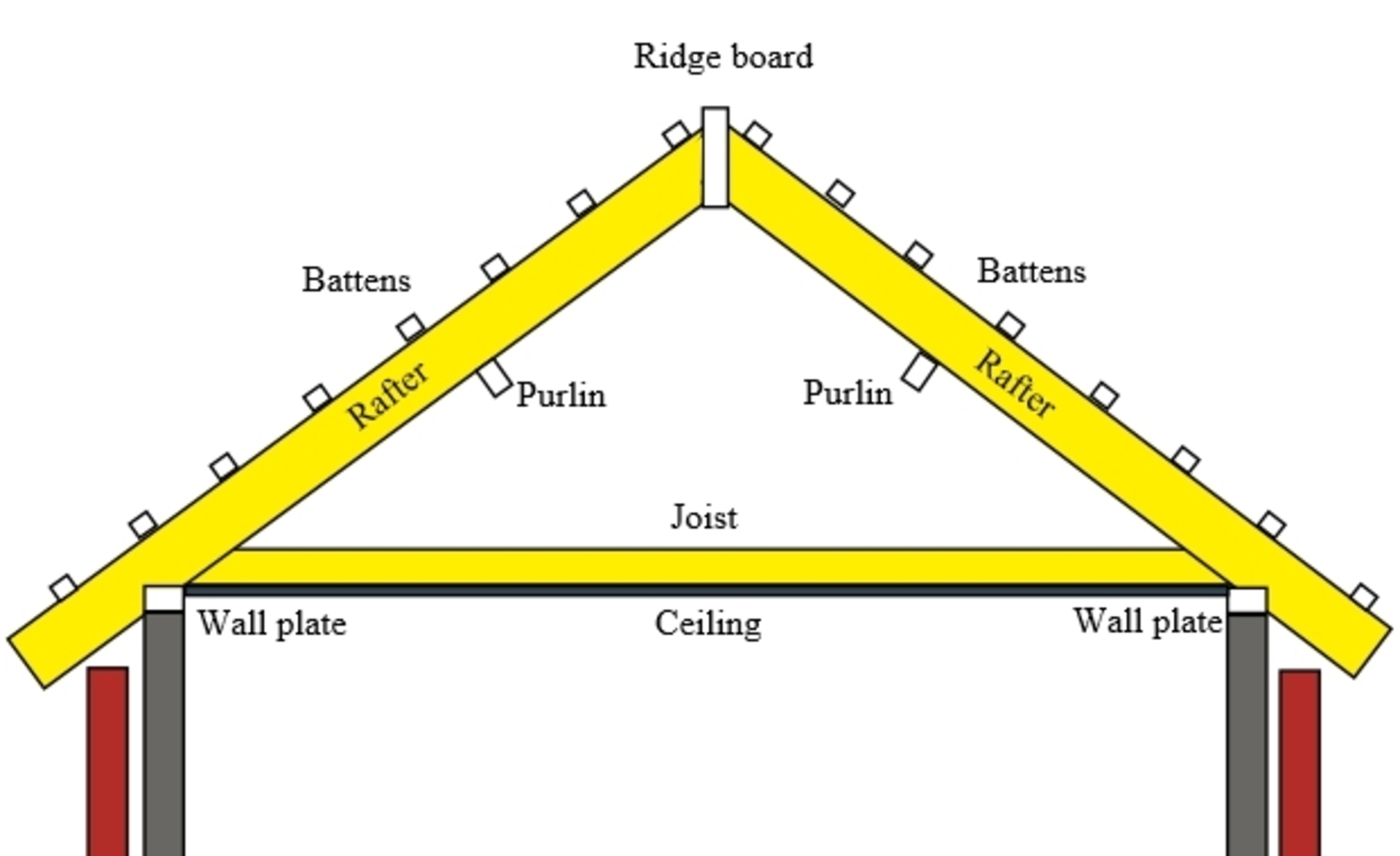
Roof rafters provide essential functions:
- Provide inclined support for roof decking
- Transfer roof gravity and wind loads to walls below
- Tie the structure together at eave lines and ridge line
- Give the roof its sloped shape and architectural form
Understanding how to properly design and install roof rafters ensures structural integrity and weather-tightness for the entire building.
Roof Rafter vs. Truss
Roof rafters are sometimes confused with trusses. Though both are sloped structural elements, there are key differences:
Rafter
- Individual angled members
- Spaced apart at regular intervals
- Often have triangular cross-section
- Transfer loads primarily along their lower edge
Truss
Trusses allow roof systems to span greater distances, but require more complex design and fabrication. Rafters provide a simpler framing solution well suited to smaller roof dimensions.
How Roof Rafters Work
To understand how rafters work structurally, we must consider:
Transfer of Gravity Loads
The angled shape allows rafters to efficiently resolve the roof’s weight into vertical and horizontal forces that can be carried down into the walls below. The triangular layout gives rafters added rigidity.
Resisting Wind Uplift
During strong winds, negative pressure tries lifting the roof upwards. Rafter ties and ridge connections allow rafters to work together resisting these uplift forces.
Forming Roof Pitch
Rafter angle and length determines the roof slope or pitch. The pitch influences rainwater drainage and architectural styles.
Providing Load Path
Rafters transfer wind and gravity loads along a clear load path through bearing walls into the foundation. This maintains structural stability.
Lateral Bracing
Collar ties, gusset plates, sheathing and other bracing laterally restrain rafters, preventing buckling failure.
Proper rafter design, installation and bracing enable roofs to withstand large forces experienced throughout the building’s service life.
Roof Rafter Design Considerations
Designing appropriate rafters for a building requires assessing several key factors:
Design Loads
The rafter size must be adequate to support expected dead, live, wind, and snow loads, calculated based on local building codes.
Span
The horizontal span between bearing walls will dictate the required rafter length. The span impacts strength needs.
Pitch
The desired roof slope or pitch controls the rafter vertical rise and angle. Low pitches require longer rafters.
Materials
Wood, steel, or engineered lumber each have different strength properties for rafter design.
Layout
The on-center rafter spacing must be determined based on load demands and deck sheathing type.
Birdsmouth
The birdsmouth joint cut into the rafter where it sits on the wall plate must be properly sized.
Bracing
Supplementary bracing like collar ties prevents rafter buckling under compressive and lateral loads.
Thoroughly considering each factor using building code guidelines and structural analysis yields an optimized rafter design.
Roof Rafter Size Calculator
Proper rafter sizing requires calculating expected roof loads, then selecting a rafter depth and thickness to have adequate structural capacity. Using a roof rafter calculator simplifies analysis. Key inputs include:
- Roof span length
- Horizontal overhang dimensions
- Desired roof pitch
- Estimated roof live and dead loads
- Selected rafter material and wood grade
Typical Example with values
Here is a typical example with values for calculating roof rafter sizes using US and Indian code books, explained in simple terms for practicing civil engineers:
Let’s calculate the size of roof rafters for a residential building with the following data:
Span of roof (L): 16 ft
Spacing between rafters (S): 2 ft
Roof live load (WL): 20 psf
Roof dead load (WD): 15 psf
Snow load (Ws): 30 psf
Seismic zone factor (Z): 0.15
Importance factor (I): 1.0
Using the IRC 2018 (International Residential Code) and IS 875-1987,
Dead load: WD = 15 psf
Live load: WL = 20 psf
Snow load: Ws = 30 psf
Total uniform load on rafter, Wu = 1.2(WD + WL + Ws)
= 1.2(15 + 20 + 30)
= 1.2(65)
= 78 psf
Bending moment, M = (Wu x L2) / 8
= (78 x 16 x 16) / 8
= 2464 ft-lb
Allowable bending stress, Fb = 850 psi (for Douglas Fir-Larch No.2)
Required section modulus, Z = M / Fb
= 2464 / 850
= 2.90 in3
For 2×6 rafter (actual size 1.5 in x 5.5 in)
Section modulus, Z = (bd2)/6
= (1.5 x 5.52) / 6
= 3.61 in3
Therefore, 2×6 size Douglas Fir-Larch rafter at 2 ft spacing is adequate.
The steps are in accordance with Chapter 8 of IRC 2018 and Clauses 23.4, 28.1.1, 28.2.1.1 and 28.3.1 of IS 875-1987. All relevant formulas used are shown.
With these inputs, the calculator analyzes forces and structural capacity to output an appropriately sized rafter. It also computes optimal rafter spacing.
Online rafter calculators like those from major wood product suppliers can automate analysis using common building code guidelines, removing guesswork from sizing. Let me know if you need any clarification!
Roof Rafter Dimensions
Some key rafter dimensions must be determined from analysis or design tables:
- Rafter horizontal span length
- Total rafter length accounting for pitch
- Rafter height and vertical rise
- Rafter thickness and depth
- Birdsmouth notch depth and seat cut dimensions
- Eave overhang sizes
Span tables in building code books provide precalculated maximum rafter spans for different wood species, sizes and load conditions.
Roof Rafter Span Tables
Rafter span tables simplify sizing by providing maximum horizontal span lengths for rafters based on:
- Rafter material (Douglas fir, pine, etc)
- Size of rafter (2×4, 2×6, etc)
- Allowable bending stress for material
- Roof live and dead load assumptions
Table R802.5.1(1) – Allowable rafter spans for common lumber species (ft-in)
Rafter Spacing (inches)
| Nominal Size | Species and Grade | 12″ Spacing | 16″ Spacing | 24″ Spacing |
|---|---|---|---|---|
| 2×4 | Douglas Fir-Larch SS | 9-11 | 8-8 | 7-5 |
| 2×4 | Hem-Fir SS | 9-6 | 8-5 | 7-2 |
| 2×4 | Southern Pine SS | 9-11 | 8-8 | 7-5 |
| 2×4 | Spruce-Pine-Fir SS | 9-6 | 8-5 | 7-2 |
| 2×4 | Douglas Fir-Larch #1 | 12-6 | 11-1 | 9-8 |
| 2×4 | Douglas Fir-Larch #2 | 10-2 | 9-0 | 7-9 |
| 2×6 | Douglas Fir-Larch SS | 14-10 | 13-0 | 10-10 |
| 2×6 | Hem-Fir SS | 13-6 | 11-10 | 10-0 |
| 2×6 | Southern Pine SS | 14-10 | 13-0 | 10-10 |
| 2×6 | Spruce-Pine-Fir SS | 13-6 | 11-10 | 10-0 |
| 2×6 | Douglas Fir-Larch #1 | 18-0 | 15-8 | 13-5 |
| 2×6 | Douglas Fir-Larch #2 | 14-9 | 13-0 | 11-3 |
| 2×8 | Douglas Fir-Larch SS | 18-2 | 15-9 | 13-6 |
| 2×8 | Hem-Fir SS | 16-2 | 14-0 | 11-10 |
| 2×8 | Southern Pine SS | 18-2 | 15-9 | 13-6 |
| 2×8 | Spruce-Pine-Fir SS | 16-2 | 14-0 | 11-10 |
| 2×8 | Douglas Fir-Larch #1 | 22-3 | 19-6 | 16-9 |
| 2×8 | Douglas Fir-Larch #2 | 18-0 | 15-8 | 13-5 |
| 2×10 | Douglas Fir-Larch SS | 21-4 | 18-5 | 15-9 |
| 2×10 | Hem-Fir SS | 18-10 | 16-4 | 13-11 |
| 2×10 | Southern Pine SS | 21-4 | 18-5 | 15-9 |
| 2×10 | Spruce-Pine-Fir SS | 18-10 | 16-4 | 13-11 |
| 2×10 | Douglas Fir-Larch #1 | 26-2 | 22-10 | 19-6 |
| 2×10 | Douglas Fir-Larch #2 | 21-3 | 18-6 | 15-10 |
| 2×12 | Douglas Fir-Larch SS | 24-6 | 21-2 | 18-0 |
| 2×12 | Hem-Fir SS | 21-8 | 18-11 | 16-1 |
| 2×12 | Southern Pine SS | 24-6 | 21-2 | 18-0 |
| 2×12 | Spruce-Pine-Fir SS | 21-8 | 18-11 | 16-1 |
| 2×12 | Douglas Fir-Larch #1 | 29-10 | 26-0 | 22-3 |
| 2×12 | Douglas Fir-Larch #2 | 24-3 | 21-1 | 18-1 |
The tables indicate the maximum distance the rafter can safely span before additional support is needed. Builders can quickly choose a standard rafter size from tables that works for the building width.
Roof Rafter Spacing
Rafter spacing, also called on-center spacing, controls the horizontal distance between adjacent rafters:
Typical rafter spacing:
- 16″ on-center – For asphalt shingles
- 24″ on-center – For metal or tile roofing
- 32″ on-center – For slate or wood shingle roof
Wider rafter spacing is possible but requires larger rafters. Closer spacing maybe needed to provide rigidity or support smaller roofing materials.
Roof Rafter Ties
Rafter ties connect rafters at the ceiling line, preventing the walls from spreading outward and providing uplift resistance:
They should be continuous boards attached to rafters with nails or framing anchors. The required rafter tie depth equals the horizontal rafter span divided by 60.
Roof Rafter Details
Some other important rafter details include:
Collar Ties
Horizontal members between two rafters within upper third of attic space to brace rafters.
Gusset Plates
Triangular steel plates at rafter joints to reinforce connections.
Birds mouth Joint
Triangular notch at rafter ends allowing seating on wall plates.
Out lookers
Extended rafter ends forming architectural overhangs.
Roof Ventilation
Vents along ridge and eave lines to circulate air and prevent moisture accumulation.

Roof Rafter Brackets
Brackets help reinforce rafter connections and prevent uplift forces from separating joints. Common types:
Ridge Beam Connectors
Secure rafters to ridge beam preventing detachment under wind uplift.
Rafter Tie Connectors
Attach collar ties or rafter ties across spans to brace rafter pairs.
Gusset Plate Connectors
Tie gusset plates to rafter webs, reinforcing internal roof joints.
Roof Rafter Length Formula
The triangle formed by a roof rafter can be analyzed to determine the rafter length needed for a desired pitch on a given span:
Where:
L = Total rafter length
S = Horizontal rafter span
R = Rafter vertical rise
P = Desired roof pitch (rise/run ratio)
Using trigonometry:
L = √(S^2 + R^2)
R = S * P
Substituting:
L = √(S^2 + (S * P)^2)
This formula can calculate rafter lengths for any pitch once the rafter span is known.
Roof Rafter Pitch Calculator
A roof rafter pitch calculator quickly determines rafter angles and lengths needed for a desired roof slope. Key inputs:
- Total horizontal rafter span
- Desired roof pitch (e.g. 6:12, 8:12, 12:12)
- Rafter material size (2×4, 2×6 etc)
With these inputs, the calculator runs through the rafter length formula for the specified pitch and outputs:
- Recommended rafter length
- Rafter vertical rise height
- Cut birdsmouth notch depth
- Optimal overhang size
Online pitch calculators from building suppliers allow easy rafter design for any roof slope without intensive math.
Roof Rafter Design Guide Recap
To recap key roof rafter design considerations:
- Use span tables to determine maximum rafter spans based on size and roof loads
- Calculate rafter spacing needed to support roofing materials
- Ensure rafter ties are adequately sized to resist wind uplift
- Use hardware connectors to reinforce critical rafter joints
- Cut proper birdsmouth notches for seating rafters on walls
- Use collar ties and other bracing to prevent rafter buckling
- Employ rafter length formulas and calculators to determine angles and lengths
- Select optimal eave overhang size for weather protection
Proper application of building codes, structural analysis, and construction best practices in rafter design results in a roof system with full structural integrity.
Conclusion
Roof rafters provide essential structural support and framing for sloped roofs. Understanding rafter behavior, design factors like span and pitch, bracing requirements, and construction methods is critical in civil engineering.
Proper rafter design ensures roofs safely withstand all gravity, wind, and uplift loads experienced over the life of the building. Using span tables, calculators, and formulas simplifies analysis and sizing of rafter components.
When principles for sound rafter design are followed, engineers can have confidence the roof structure will achieve required performance and durability.

Clear breakdown of the rafter types, the span tables are always the tricky part. Useful reference, thanks.